Jensen Huang in Berlin – this is not what left behind looks like

What he really wanted in Berlin
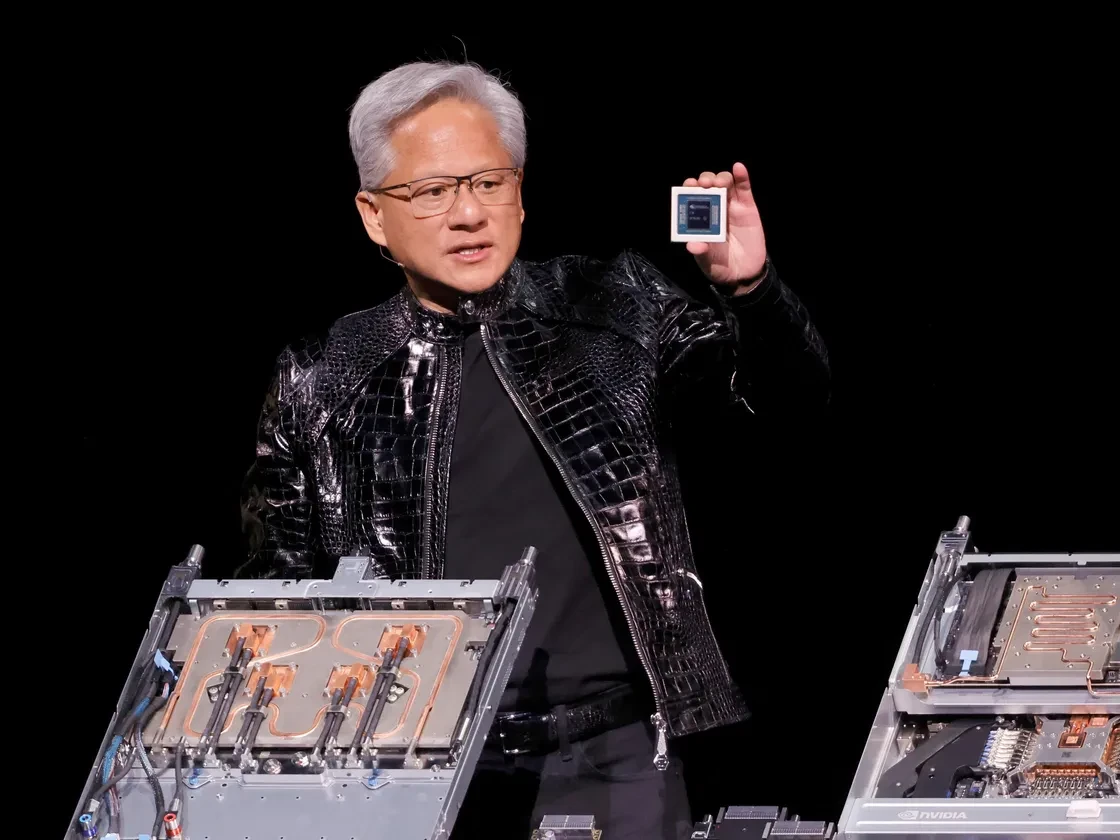
On Friday evening, the head of the world's most valuable company stood on the third floor of the Saturn store on Alexanderplatz, raffled off five laptops, signed autographs and celebrated with 500 people. Nvidia is worth more than five trillion dollars on the stock market. There were seven launch events worldwide for the new RTX Spark laptops, and Berlin was the only one Jensen Huang attended in person (Tagesspiegel).
There is more to it than a PR stunt: the raffle kicked off a week that could move quite a lot for Germany. Tonight, Friedrich Merz opens the Invest in Germany summit at Kraftwerk Berlin with around 200 CEOs, and Huang is the announced star guest, speaking with the Chancellor on stage (Berliner Zeitung, Leadersnet). That will be followed by a private conversation between the two, then a meeting with Mercedes CEO Ola Källenius. Starting tomorrow, GTC Berlin, Nvidia's developer conference, runs at the Tempodrom, with Huang's keynote on Wednesday (Nvidia).
The real reason for the trip is the AI pact that Merz and Huang plan to announce today. The federal government is putting in a nine-figure sum, Nvidia is supplying engineers and chips, and around a dozen German companies are taking part, including Siemens, Audi and Black Forest Labs. The goal is physical AI, meaning models for robots and autonomous vehicles, trained on German industrial data using computing capacity in Telekom's data center (Borncity, WinFuture).
Asked why Berlin, Huang himself gave the clearest answer: Germany is Nvidia's largest European site, and it has telecommunications, robotics, autonomous vehicles and plenty of AI research. And he continues to call the auto industry, which everyone is currently condemning, extremely important for Nvidia, from styling to simulation and manufacturing to the technology inside the vehicle. Someone who talks about a country this way has not given up on it. He wants to sell there.
The remark that stuck
What stuck from this week above all was a single remark from London. At a press briefing on Wednesday, Huang said, in essence, that nothing pained him more than seeing one of the most technologically advanced countries fall so far behind. He suggested the reason was the European habit of overthinking everything, and added that Germany has so much talent: just get to work (Leadersnet, GameStar).
I have looked at that remark for three days, and I find it wrong in its choice of words and right in its intent. Grading countries is an analyst's job; Huang is the best salesman of his generation, on a European tour through Paris, London, Stockholm and Berlin (Handelsblatt). A salesman tells the customer that he urgently needs something, and needs it now.
You can see this in what he said on ZDF two days later: German mechanical engineering and the auto industry are exactly the capabilities that need to be combined with AI (ms-aktuell). Nobody praises the substance on Friday of a country they wrote off on Wednesday. The London remark was urgency, the Berlin remark was the offer. The two belong together, and both aim at the same thing: speed.
And honestly, in Nvidia's case I buy the role. Over 30 years, the company has turned graphics cards for gamers into the infrastructure for the entire AI world, and for years Huang has been wearing the same leather jacket and carrying the same message. Anyone selling Blackwell chips has an interest in Germany getting going. In this case, that interest is identical to ours.
This is not what left behind looks like
Being left behind means you have lost your substance. Germany is leaving its substance unused, and that is a completely different problem with a completely different solution. A few figures that got lost in this week's excitement:
- Germany invests around 3.1 percent of its economic output in research and development and has about 1,700 mid-sized world market leaders, the hidden champions Huang raved about in London (Webnachrichten / IPPEN).
- Since September, Jülich has been home to JUPITER, Europe's first exascale supercomputer and, according to Merz, number four worldwide. 500 million euros, nearly 24,000 Nvidia GH200 Grace Hopper superchips, with waste heat warming the campus (EuroHPC, Börse Express).
- Since this year, Telekom's Industrial AI Cloud has been running in Munich: around 10,000 Blackwell GPUs, up to 0.5 exaFLOPS, one billion euros, entirely privately financed and taken from idea to operation in six months (Telekom, heise). Six months. That is hardly the pace of a country that has been left behind.
- Black Forest Labs from Freiburg sits in the pact alongside Siemens and Audi. It is one of the most relevant image model teams in the world, founded by people who previously worked on Stable Diffusion at Stability AI, and it comes from the Black Forest rather than Palo Alto.
- And Nvidia itself has its largest European site here, ahead of London or Paris. Huang said so himself in Berlin on Friday (Tagesspiegel).
Computing power, talent and industrial know-how are all there. What is missing is the willingness to connect it all without three committees and two expert reports. The hardware is in Jülich and Munich. The data sits on the factory floors of 1,700 world market leaders. What is missing in between is the courage to simply start and let the first model be bad.
I see this every week in my own surroundings. Between the Berlin lab and the Chiemgau, where I am sitting right now, there are hundreds of businesses whose machines generate data that no one has ever fed into a model. It would have been possible long ago; nobody ever asked for it. That is untapped potential, and you unlock it with a concrete occasion.
Why the pact is an opportunity
The opportunity lies in the part of AI where Germany can still win: physical AI. With language models, the train has left for the US and China, and we have to be honest about that. With robots, factories, vehicles and machines that move things in the real world, the winner is whoever has the data on how the real world behaves. That data sits in German factory halls, test benches and vehicle fleets, and that is exactly what the pact targets, with robotics and autonomous driving at its core (Borncity).
The second point is sovereignty, and here I find Huang's definition more useful than most contributions to the German debate. He says, in essence: Nvidia sells chips and does not offer end-user services; the services should run in Germany so that control over data and the ability to act stay here (Tagesspiegel, Dr. Web). Of course, that is a chip seller's definition, and the supply chain remains a dependency. But Europe will not build its own GPU manufacturing in the next ten years, and anyone who waits for it will lose the application layer along with it. Better Blackwell chips in Munich under German operation than no models at all.
The third point is the timeline. If the federal government comes in with a nine-figure sum, Siemens, Audi and Black Forest Labs take part, and the computing capacity in the Industrial AI Cloud is already in place, then the project needs one thing above all: mid-sized companies that put their data in. That is the real invitation of this week. The pact is the scaffolding; the businesses have to put up the walls.
And yes, Nvidia earns money at every single step. That is no argument against it. Nobody asked Deutsche Bahn to lay tracks free of charge when the country was industrializing. Huang is delivering the rails for the next industrialization, and he is delivering them to Berlin, of all places, instead of Paris or London. That can be read as a compliment, even if it was packaged as a reprimand.
The kick in the pants
Germany has had enough wake-up calls over the last ten years. What helps now is a kick in the pants in the best sense, meaning a concrete occasion with a date, a budget and participants. That is exactly what this week in Berlin is: summit today, pact today, GTC from tomorrow, keynote on Wednesday. Anyone with responsibility in an industrial company has no excuse for the next four days not to take a look.
For two years with EXECUTE, I have done nothing else but build bridges between the Berlin lab and Bavarian mid-sized companies, and I know both sides. The Berlin scene likes to talk about sovereignty and builds little. The Mittelstand builds every day and never talks about AI, because it is too busy staying a world market leader. The pact is made for the second group, and they don't know it yet.
My suggestion to anyone who has a factory hall, a test bench or a fleet: watch the keynote on Wednesday and ask yourselves with every example whether your machine would have the data for it. The answer is almost always yes. Then call someone who knows how to get the data into a model. No expert report, no advisory board, just a pilot on one machine, with results in twelve weeks.
Huang is right about the overthinking. He is wrong about being left behind. You are left behind when you can no longer catch up, and Germany can, with JUPITER in Jülich, 10,000 GPUs beneath Munich and 1,700 world market leaders who have never touched their data. On Friday the man raffled off laptops on Alexanderplatz, today he negotiates with the Chancellor, and on Wednesday he delivers the keynote at the Tempodrom. There will be no bigger invitation than this.
Johannes Lex is co-founder of EXECUTE in Berlin and works from the Chiemgau on industrial, robotics and venture projects. This text is part of the Monday column, which appears here every week.